Task Mining vs. Process Mining: A Comparison Guide for Enterprise Teams
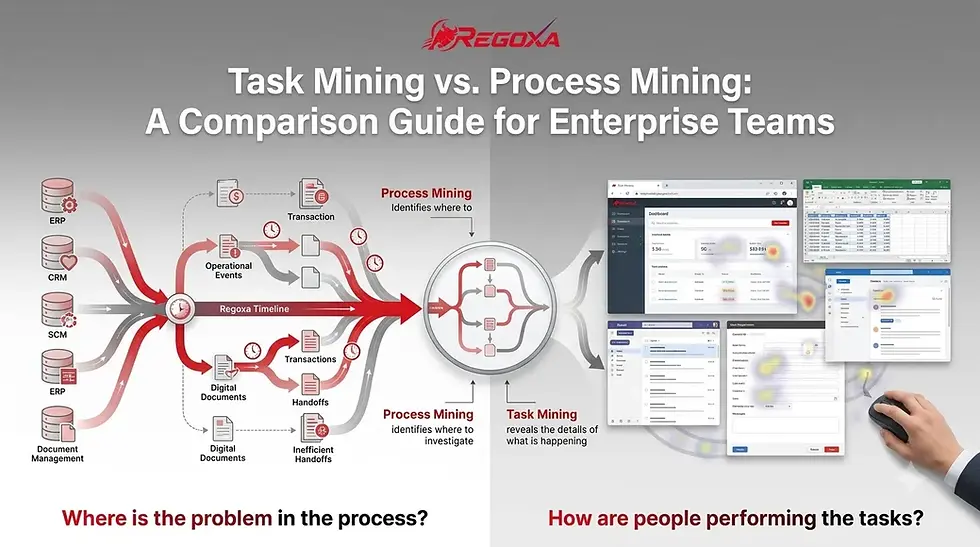
When an operational process isn't performing the way it should, there are two questions worth asking. The first: where in the process is the problem occurring? The second: how are people actually performing the tasks inside that process? These questions sound similar. They aren't. Each one requires a different analytical approach, a different data source, and a different type of insight to answer it. That's the core of the task mining vs. process mining comparison—and understanding which question each technique answers is what determines which one your organization needs and when.
Task Mining vs. Process Mining: Two Angles on the Same Operational Problem
Both task mining and process mining aim to improve how work gets done. Both rely on data from the systems your organization already uses. But they start from opposite ends of the operational picture.
What Task Mining Reveals About How Work Actually Gets Done
Task mining analyzes how individual employees interact with software at the user interface level. It captures the specific actions people take when completing a task—which applications they open, what data they enter, which steps they follow in which order, where they switch between systems, and where they spend time waiting or repeating steps unnecessarily. The data source is user activity: mouse movements, keystrokes, screen recordings, and application-level events. Task mining builds a picture of what actually happens on an employee's screen during a business task, rather than what a process diagram says should happen.
This level of detail is valuable precisely because it's invisible to most other analytical approaches. A process map might show that a loan application moves from submission to credit check to underwriting. Task mining shows that during the credit check stage, the analyst opens three separate systems, copies data between two of them manually, and runs a check twice because the first system times out. Those are the inefficiencies that never appear in system logs.
What Process Mining Reveals About How Workflows Actually Flow
Process mining works from the other direction. Rather than watching individual users, it reads the event logs that enterprise systems generate as a byproduct of normal operation—the timestamps, activity records, and case IDs from ERP, CRM, and workflow platforms. From that data, process mining reconstructs end-to-end process flows: how cases actually moved through the system, which paths were most common, where deviations from the expected sequence occurred, which steps took longest, and where cases piled up waiting for the next action. The picture process mining produces is a data-driven map of the complete workflow—across every case, every team, and every system involved in the process. Individual user behavior doesn't appear in this picture. What appears is the aggregate pattern of how hundreds or thousands of workflow instances actually executed.
How Task Mining and Process Mining Differ in Practice
The comparison is clearest when mapped directly:
| Task Mining | Process Mining |
Core question | How do individuals perform this task? | How does this process flow end-to-end? |
Data source | User interactions, screen activity, application events | System event logs from ERP, CRM, and workflow platforms |
Level of analysis | Task and user level | Process and workflow level |
What it reveals | Individual inefficiencies, workarounds, and manual steps | Process variants, bottlenecks, and systemic deviations |
Blind spot | Misses the broader process context around individual tasks | Misses what happens inside a task at the user level |
Best for | Finding automation opportunities in specific employee tasks | Measuring and optimizing end-to-end workflow performance |
Output | Task-level improvement and RPA automation targets | Process maps, variant analysis, performance metrics |
Neither row is stronger. Task mining and process mining see different parts of the same operational reality. Their insights complement each other—which is why the most useful question isn't which to choose, but which to start with given the problem you're trying to solve.
When Should You Use Task Mining?
Task mining is most valuable when the problem is located inside a task rather than between tasks. If employees are spending significant time on a specific activity—and the question is why and what they're actually doing during that time—task mining provides the answer.
Task Mining Use Cases in Financial Services and Insurance
In financial services, task mining frequently surfaces in processes where employees work across multiple systems without integration between them. A loan review analyst who copies applicant data from a submission portal into a credit checking system and then again into an underwriting platform is performing manual steps that the process map records as a single "credit assessment" task. Task mining makes those steps visible. In insurance, claims handlers often develop informal workarounds when standard systems don't meet the requirements of complex cases. Those workarounds—which may involve switching between four or five applications—are invisible to process mining but appear immediately in task mining data. Identifying them is the first step toward either standardizing the workaround or automating it.
Task Mining Use Cases in Logistics and Healthcare
In logistics operations, task mining use cases often appear in manual coordination activities: updating shipment statuses across multiple tracking systems, reconciling delivery records between carrier portals and internal platforms, or resolving discrepancy reports that require accessing three separate databases. The task looks routine on paper. Task mining reveals how time-consuming and repetitive it actually is.
In healthcare administration, task mining surfaces the detailed reality of patient intake, insurance verification, and billing processes where staff navigate multiple systems under time pressure. Understanding those specific sequences is what makes targeted automation feasible—and what prevents automation teams from building robots that replicate inefficiencies rather than eliminate them.
When Should You Use Process Mining?
Process mining is most valuable when the problem is visible at the workflow level—when something in the end-to-end process is producing unexpected cycle times, high exception rates, or compliance deviations across many cases simultaneously.
Process Mining Benefits and Use Cases Across Operations
The process mining benefits that matter most to enterprise operations teams show up in specific, measurable ways.
End-to-end visibility: Process mining produces a complete, data-driven picture of how a workflow actually executed across every case in the dataset—not a sample, not a survey, but the full record of what happened.
Bottleneck identification: Where in the process do cases slow down? Which step consistently takes longer than the designed cycle time? Where do cases wait for human action when they could be moving automatically? Process mining answers these questions precisely, with the frequency and duration data needed to prioritize which bottleneck to address first.
Variant analysis: Most processes have a primary path and a long tail of variants—alternative routes that cases take when something deviates from the expected sequence. Process mining quantifies those variants. In some operations, a small number of variants account for a disproportionate share of processing time and cost. Identifying them is the first step toward addressing them.
Compliance monitoring: For regulated industries, process mining provides auditable evidence of how processes actually executed, which steps were followed, and where deviations from required procedures occurred.
Process mining use cases are strongest in high-volume transactional processes: accounts payable, order-to-cash, customer onboarding, claims processing, and any workflow that runs thousands of times and where small inefficiencies multiply into significant operational cost.
Why Both Together Give You the Complete Picture
Process mining tells you where in a workflow the problem is. Task mining tells you how the problem manifests at the human level. Together, they close each other's blind spots. Consider an accounts payable process where process mining reveals that invoice approval is consistently taking four days longer than expected. That's where. Task mining then reveals that AP staff are spending a significant portion of that time copying invoice data between two systems because the integration between them never got built. That's the how. Neither insight alone is actionable without the other. The process mining finding directs attention to the right stage. The task mining finding identifies what's actually happening inside it. The solution—in this case, likely an integration or an automated data transfer—becomes clear only when both pictures are visible. This is why the task mining vs. process mining question isn't really a choice. Organizations that treat them as alternatives end up with either a macro view without the detail to act on it or a detailed view without the process context to prioritize it.
Task Mining, Process Mining, and Process Intelligence
Task mining and process mining are often discussed as a pair. Process intelligence is the broader discipline that gives both techniques operational context. Task mining reveals what happens at the user level inside a specific step. Process mining reveals what happens across the complete workflow at the system level. Both produce useful analytical output. Neither, on its own, connects that output to the ongoing operational decisions an enterprise needs to make.
Process intelligence is what closes that gap. It extends process mining through analysis, monitoring, prediction, and simulation, turning a one-time discovery exercise into a continuous operational capability. Task mining findings feed into this framework by identifying the specific desktop-level inefficiencies that process mining surfaces as unexplained time loss inside a stage.
The relationship looks like this in practice. Process mining identifies that an invoice approval stage is taking four days longer than expected. Task mining identifies that AP staff are spending most of that time manually copying data between systems that should be integrated. Process intelligence provides the broader context: how often does this pattern occur, which cases are affected, is the problem getting worse or better over time, and what would happen to the overall workflow if the integration were built?
Together, the three approaches cover different parts of the same question: how does work actually move through the organization, and where can it be improved? Process mining provides the workflow picture. Task mining provides the human activity detail inside specific steps. Process intelligence connects both to the decisions that need to be made. Regoxa Timeline provides the pro
cess intelligence layer in this combination. Process Discovery and Process Analysis establish the workflow picture. Process Monitoring, Process Prediction, and Process Simulation extend that picture into ongoing operational management. For organizations using task mining to identify automation opportunities, Regoxa Timeline provides the process-level evidence that shows which opportunities will have the greatest impact on end-to-end workflow performance.
How Regoxa Timeline Supports Process Mining and Process Intelligence
For enterprise teams working through this combination, Regoxa Timeline provides the process intelligence layer that makes process mining operationally useful rather than analytically interesting.
Process Discovery reconstructs actual process flows from the event log data your enterprise systems already generate. The output is a data-driven process map showing how work actually moved—every path, every deviation, every case that took a different route than expected. This is where process mining begins in practice: with an accurate picture of the current state rather than a documented assumption of what it should be.
Process analysis goes deeper—measuring cycle times at each stage, quantifying how frequently each variant occurs, and identifying the root causes of delays with the specificity needed to act on them. Rather than knowing that the approval stage is slow, process analysis shows which specific sub-steps are consuming the time and how often the pattern repeats.
Process monitoring keeps that picture current after improvements are made. Rather than running a one-time process mining exercise and moving on, teams can watch live process behavior, catch new deviations as they emerge, and confirm that changes are holding rather than discovering six months later that the process has drifted again.
Process prediction extends the view forward. Using historical process data, it identifies cases currently in flight that are on track to miss SLAs or follow a problematic variant—while there's still time to intervene. For operations managing large case volumes, this changes the dynamic from reactive problem-solving to proactive case management.
Process simulation allows teams to test proposed changes against historical process data before committing resources to implementation. Rather than discovering after a process redesign that it produced a new bottleneck somewhere else, simulation reveals those consequences in advance.
For organizations also running document-heavy workflows, Regoxa IDP Analytics connects document processing performance to process-level outcomes, making visible the cases where a document bottleneck is extending a broader workflow cycle to see how Regoxa Timeline supports process mining and process intelligence in your specific operational environment.
Key Takeaways
Task mining analyzes how individuals interact with systems at the user interface level—revealing the manual steps, workarounds, and inefficiencies that happen inside a task but don't appear in system logs
Process mining analyzes event log data from enterprise systems to reconstruct end-to-end workflow flows—revealing bottlenecks, variants, and systemic deviations across large case volumes
The core difference is data source and scope: task mining sees what happens on an employee's screen; process mining sees what happens across the complete workflow in the system
The process mining benefits that matter most—bottleneck identification, variant analysis, compliance monitoring, and cycle time measurement—require system-level event data, not user observation
Both approaches are most valuable together: process mining identifies where in the workflow the problem is; task mining explains how it manifests at the human level
Regoxa Timeline provides process discovery, analysis, monitoring, prediction, and simulation—the full process intelligence stack that makes process mining operationally actionable
Frequently Asked Questions
What is task mining, and how does it work?
Task mining analyzes how individuals interact with software at the user interface level—capturing mouse clicks, keystrokes, application switches, and data entry sequences to reveal exactly how employees perform specific business tasks. It works by recording user activity across desktop applications and building a picture of the actual steps involved in completing a task, including the manual workarounds and redundant actions that don't appear in system logs or process documentation.
What is process mining, and how does it differ from task mining?
Process mining analyzes event log data generated by enterprise systems—ERP, CRM, and workflow platforms—to reconstruct end-to-end business process flows. Where task mining focuses on individual user behavior at the screen level, process mining focuses on aggregate workflow patterns across hundreds or thousands of cases. Task mining shows how a person performs a task. Process mining shows how a process executes across the entire operation.
What are the main process mining benefits for enterprise operations?
The core benefits are end-to-end process visibility, bottleneck identification with specific cycle time data, variant analysis showing how frequently cases deviate from the expected path, compliance monitoring with auditable execution records, and the ability to measure process performance continuously rather than through periodic manual reviews. For high-volume transactional processes, these benefits translate directly into measurable reductions in cycle time and operational cost.
When should an organization start with task mining rather than process mining?
Start with task mining when the problem is already localized to a specific task or activity and the question is what employees are actually doing during that task. It's also the right starting point when the goal is identifying RPA automation opportunities—task mining reveals the specific user interactions that robots can replicate. If the problem is broader—a process that's slow or generating exceptions without a clear cause—start with process mining to find where the issue is before investigating how it manifests.
What are the most common task mining use cases?
Task mining use cases appear most frequently in processes where employees work across multiple systems without integration between them—loan processing, claims handling, logistics coordination, billing and reconciliation, and any activity where staff copy data between applications manually. It's particularly useful where employees have developed informal workarounds that are faster than the official procedure, because those workarounds are invisible to other analytical approaches.
Can task mining and process mining work together?
They work better together than either does separately. Process mining identifies where in a workflow the problem is occurring—which stage is slow, where cases deviate, and where the compliance risk concentrates. Task mining then reveals what's happening inside that stage at the user level—the specific manual steps, application switches, and workarounds that are driving the issue. Together, they provide both the where and the how needed to design a targeted solution.
How does Regoxa Timeline support process mining for enterprise teams?
Regoxa Timeline provides the full process intelligence stack: Process Discovery reconstructs actual process flows from system event data, Process Analysis measures performance and root causes at each stage, Process Monitoring watches live execution and flags deviations in real time, Process Prediction identifies cases likely to breach SLAs before the outcome is locked in, and Process Simulation tests proposed changes against historical data before implementation. Together, these capabilities make process mining operationally actionable rather than a one-time analytical exercise.
What is the difference between task mining and process discovery?
Task mining and process discovery are often confused because both produce a picture of how work happens, but they operate at different levels and from different data sources. Task mining captures what individual employees do on their screens during a specific task. It records user interactions at the desktop level: which applications are opened, what data is entered, how users navigate between systems, and where manual steps accumulate. The output is a detailed map of human activity inside a task.
Process discovery is a technique within process mining that reconstructs end-to-end process flows from event log data generated by enterprise systems. It shows how cases actually moved through the workflow: which paths were taken, where deviations occurred, and how often each variant appeared. The output is a data-driven model of workflow behavior at the system level.
The practical difference: task mining shows what a person does during a specific step. Process discovery shows how that step fits into the broader workflow and how consistently cases move through it. For organizations evaluating where to focus automation effort, process discovery identifies which stages of the workflow have the greatest variation or delay. Task mining then explains what is happening inside those stages at the human level.
Is task mining part of process intelligence?
Task mining is related to process intelligence but is not always included within it as a core component. The answer depends partly on how a vendor or organization defines the scope of process intelligence.
Process intelligence typically encompasses process mining, process analysis, process monitoring, process prediction, and process simulation. These capabilities all work from system event log data generated by enterprise platforms. Task mining works from a different data source: user interaction data captured at the desktop level. Because the data source and the level of analysis differ, task mining is often positioned as a complementary discipline rather than a subset of process intelligence.
In practice, the two work well together. Process intelligence provides the end-to-end workflow picture grounded in system data. Task mining fills in the detail about what employees are doing inside specific steps that system logs do not capture. Organizations that use both get a more complete view of where inefficiency lives and what is causing it than either approach delivers alone. Regoxa Timeline focuses on the process intelligence layer: process discovery, analysis, monitoring, prediction, and simulation grounded in system event data. For organizations that also use task mining tools to analyze desktop-level activity, Regoxa Timeline provides the broader process context that determines which task-level findings are most worth acting on.
Comments